A Late-Summer Walk Through a Working Orchard
A late-summer orchard walk reveals how rows, harvest activity and public paths fit together, while helping you observe the working landscape without disturbing it.
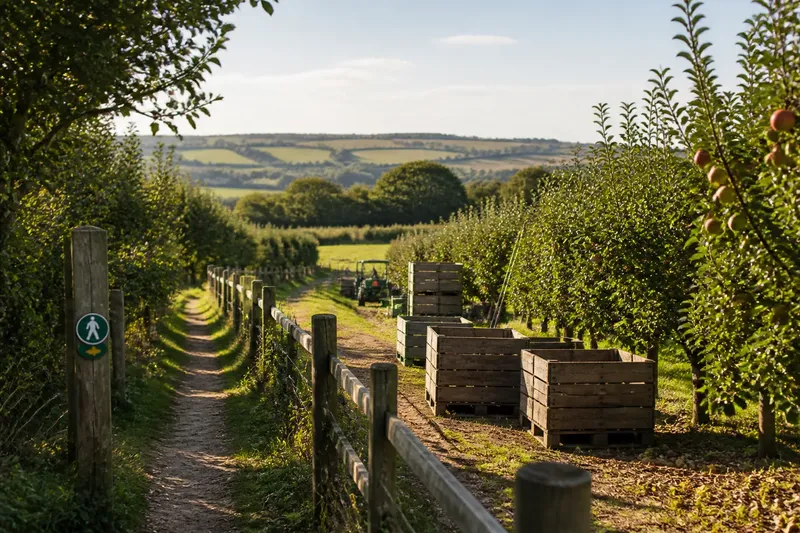
Which details can you notice on a late-summer orchard walk without stepping into the work? From a signed public path, rows, service lanes and harvest containers can show how the landscape is arranged, while posted access rules tell you where to stay.
Keep your observations to what you can see from the route. A stack of bins or a change in row direction may offer a useful clue, but neither explains every decision behind the orchard’s work.
Find and follow the public route
Before setting off, identify a route that is clearly open to walkers, such as a signed public footpath or designated orchard trail. A farm track may look like a shortcut but still be private; an open gate is not, by itself, permission to enter.
Watch for signs, fences, gates and changes in the path. If access is unclear, stay on the public side or choose another walk rather than asking a busy worker to settle the question.
Keep dogs close and under control, and leave room for people carrying produce or moving equipment. If a vehicle approaches, step aside only where it is safe and permitted.
Read the orchard layout from the edge
From the path, notice whether rows run across a slope, follow the ground or stop at a boundary. Their arrangement shows part of the orchard’s pattern, not the full reasoning behind it.
Look for changes between blocks: different tree forms, gaps between rows, grassed strips or shifts in ground cover. These may mark distinct sections or practical routes. A lane through the trees may be for farm traffic, so do not enter just because it looks empty.
Notice what borders the planted area, too. A windbreak, drainage ditch, hedgerow or open strip can shape the edge and influence how people and vehicles move. Observe from the path without climbing fences or leaning across them.
Notice signs of seasonal work
Late summer can bring visible activity, though tasks vary with the fruit and local conditions. You might see harvest containers, ladders, picking equipment, irrigation lines or fruit being sorted near a packing area. Treat these as signs of work in progress, not reasons to approach.
Notice where equipment sits and which spaces have been left clear. A quiet row may still be part of an active route, and bins may be waiting for handling. Do not touch fruit, tools, machinery, containers or irrigation fittings.
Say you are on a signed path beside an orchard and see empty bins near a service lane. You note their position from the path, then continue without crossing the boundary or photographing anyone at work. The bins suggest a working route, but you cannot tell from that view what task comes next.
Observe harvest cues without guessing
Fruit colour, fallen produce and activity near a block may suggest that harvest is under way or approaching. Appearance alone cannot tell you which fruit is ready, what quality the grower needs or whether a particular row is being picked.
Notice how activity differs across the view. One area may be quiet while another has people or bins moving through it. That contrast is visible; the reason for it may not be, so there is no need to infer a schedule or question workers who are busy.
Take photographs only from a permitted place. Frame rows, tree canopies or the public path rather than identifiable workers, private yards or areas marked as off limits. Put the camera away if taking pictures narrows the path or distracts you from nearby activity.
Give workers and the route room
Keep a steady pace and give workers space. Do not call across rows, follow someone to learn what they are doing or wait beside a work area for a photograph. If a worker speaks to you, answer briefly and follow any request to move or use another route.
Leave fruit where it is, including fallen fruit beside the path. Pick it only in a clearly marked pick-your-own area and under its stated visitor rules. Take litter with you, and do not block gates, driveways or entrances while stopping to look.
If activity makes a narrow section awkward to pass, turn back rather than edging into the work zone. A clear view is not worth obstructing someone’s route.
What can you learn from the path?
Can I tell which fruit is growing?
You may recognise visible fruit, but distance, leaves and tree shape can make identification uncertain. Use visitor signs where available; otherwise, treat a guess as a guess.
Can I pick fruit beside a public path?
Being able to reach a branch does not make its fruit available to walkers. Leave it untouched unless the orchard clearly marks a pick-your-own area and explains its rules.
Can I photograph people working?
A public viewpoint does not make a worker part of your visit. Focus on the broader landscape and avoid identifiable close shots that could intrude on someone’s task.
What should I do if a track is unsigned?
Do not assume an unblocked track is open to walkers. Stay on a route you know is public and choose another viewpoint if access is uncertain.
Leave with a grounded impression
Before you leave, look back from the public path at how the rows, service lanes and boundaries fit together. The view can reveal a working pattern without showing every task or explaining every decision behind it.
A late-summer orchard walk is clearest when you separate what you can observe from what you can only guess. Follow the public route, notice what the season makes visible and leave the work undisturbed; that distinction helps you see both the landscape and the limits of your view.